
Your cart (0)
Your cart is empty
Tax included and shipping calculated at checkout
Drawer menu
Tax included and shipping calculated at checkout

Contents
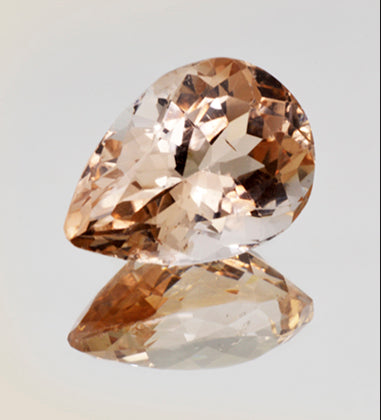
The most valuable topaz colors are vivid pink and red, followed by rich orange topaz. These hues can exceed $1,500 per carat, while blue topaz—commonly treated—rarely exceeds $60 per carat, making it one of the most affordable gemstones.

White or Colorless Topaz is an affordable gemstone. Its hardness (8 on the Mohs Scale), transparency, brilliance, and low price make this white gemstone an excellent choice for jewelry.

Due to its prismatic crystal habit, topaz is often cut into elongated shapes such as rectangular, emerald, oval, or pear cuts.
Blue topaz is cut into any style and size.
Blue topaz is available in large sizes, whereas red and pink topaz are typically found in smaller sizes.

Most topaz gemstones are eye-clean, meaning they have no visible inclusions to the naked eye. Red and pink topaz may display more internal features, which is common for these rarer colors.
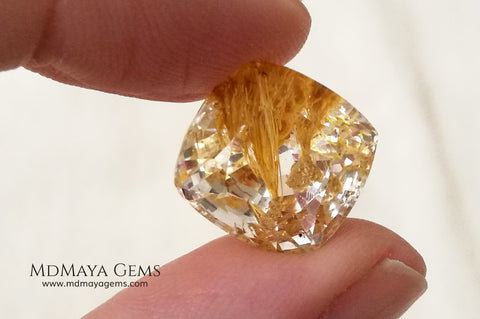
Rare white topaz with golden internal features
Biphasic and triphasic inclusions with immiscible liquids, veils, fingerprints, feathers, and solid inclusions (hematite, fluorite, etc.). Solid inclusions may show “comet tails.” Needle-like rutile inclusions and straight growth lines can also appear.

Biphasic inclusion
Topaz most commonly occurs in pegmatites, granites, and rhyolites (igneous rocks), and it can also be found in secondary alluvial deposits.
Afghanistan, Brazil (Ouro Preto–Minas Gerais), Burma (Myanmar), Canada, China, Kazakhstan, India, Madagascar, Mozambique, Namibia, Pakistan, Russia, Sri Lanka, Tajikistan, Ukraine, USA, Vietnam, Zimbabwe…

Topaz and Citrine are the birthstones for November. Blue topaz is traditionally gifted for 4th wedding anniversaries, while Imperial topaz marks the 23rd anniversary.
More information about Birthstones.
Believed to make us stronger, restore the soul, dispel anger, break spells, ease insomnia, and promote long life—these are some of the legends attributed to topaz through the centuries.

Irradiation + heat treatment: Colorless topaz is irradiated to produce brown topaz, which is then heated to remove the brown component, resulting in blue topaz. The color is stable under light exposure.
Irradiation: Colorless topaz is irradiated to produce brown topaz; this color is unstable when exposed to sunlight.
Heat Treatment: Orange-brown topaz can be heated to turn pink or purple. (Natural pink topaz is rare.)
Coating: A thin film (microns thick) is applied to the surface to impart or alter color. When metallic material is deposited, the result is “Mystic Topaz” or “Rainbow Topaz.” This coating is delicate and not permanent.
Non-commercial.
Citrine, Smoky Quartz, Glass.

Solid inclusions

Solid inclusions with "comet tail"

Aluminium silicate that contains fluorine and hydroxyl. Al2 (F,OH)2 SiO4


