
Your cart (0)
Your cart is empty
Tax included and shipping calculated at checkout
Drawer menu
Tax included and shipping calculated at checkout

Pearls are one of nature’s most extraordinary gifts — organic gems born from the heart of mollusks and shaped by time, biology, and water. Whether formed naturally or cultivated by human hands, pearls have captivated civilizations for millennia. In this guide, we’ll explore everything you need to know to understand and appreciate these timeless treasures: from their formation and varieties to their quality factors, treatments, and cultural significance.
Whether you're a gem lover, a collector, or simply looking to create meaningful jewelry, this guide is your starting point.
Contents
Pearls have adorned the human body for more than 4,000 years. Writings referencing pearls date back to 2500 B.C., testifying to their long-standing value and symbolism.

In India, pearls held religious significance and were worn by both men and women. Later, Alexander the Great brought pearls to ancient Greece, where they became a fashionable ornament until the fall of the Roman Empire. The fascination with pearls resurfaced during the Renaissance (15th–17th centuries), when they were again treasured for their natural elegance.
At the end of the 19th century and the beginning of the 20th, pearls experienced unprecedented demand. This led to the overexploitation of natural pearl banks, triggering a dramatic decline in their availability. Around the same time, cultured pearls began to appear on the market, marking a new era in pearl history (1910–1920).
The name comes from the Greek word margaron, which means daughter of the sea, in reference to its origin.
The name “pearl” comes from the Greek word margaron, meaning “daughter of the sea,” reflecting its marine origin. In Latin, it became margarita — the root of many modern terms for pearl.
In Roman times, pearls were especially fashionable, with women often wearing elongated, pear-shaped earrings. The name evolved from margarita to perula, referring to the pearl’s shape. Eventually, it became the English word pearl.

A pearl is an organic gem of animal origin. It forms as a defensive response of a mollusc (typically lamellibranch or bivalve species) to a foreign body — like a grain of sand, larva, or shell fragment — becoming lodged in its tissues.
To protect itself, the mollusc forms a depression in its mantle, enclosing the intruder in epithelial tissue. These cells then secrete nacre, which is deposited layer by layer around the foreign object, forming a pearl with a concentric structure.
Nacre consists of tabular aragonite crystals (CaCO₃) arranged in a network of conchiolin, a set of complex proteins.
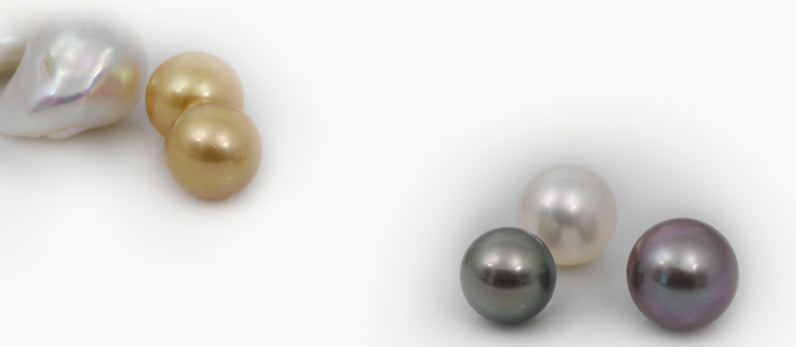
Pearls grow at a rate of about 4–5 layers per day, each around 0.5 µm thick. While the active growth period spans approximately 6 months per year, it can take 30 years for a pearl to reach 10 mm — although South Sea pearls tend to grow at nearly double this rate.
Both natural and cultured pearls thrive in similar ecosystems:
Temperature: Warm, clean waters between 20ºC and 25ºC
Depth: Between 10 and 20 meters
Survival limits: Between 10ºC and 28ºC
When water temperatures drop below 18ºC, oysters enter hibernation, limiting their productive activity to roughly half the year.
Oysters typically live 7 to 10 years, although some species can survive 30 to 40 years. However, climate change and pollution have made cultivating these organisms increasingly complex.
Cultured pearls, as we know them today, are the result of pioneering efforts by Japanese researchers Tatsuhei Mise, Tokichi Nishikawa, and Kokichi Mikimoto.

Mikimoto, in particular, devoted two decades to perfecting the technique of cultivating spherical pearls. Between 1910 and 1920, he succeeded in commercializing cultured pearls — a breakthrough that forever changed the pearl industry.
The first cultured pearls came from Pinctada martensii (Akoya oysters), which measure around 7 cm in diameter and live between 7 and 8 years.
Cultured pearls are grown on specialized farms, where oysters are either raised from larvae or collected from the wild (as in Australia).
During the larval stage, molluscs attach to branches placed underwater. After about 3 years, the larvae reach maturity and are ready for nucleation.

Once mature, the oysters are gently opened and a spherical core — usually made of nacre from freshwater molluscs — is inserted along with a piece of epithelial tissue. The mollusc then begins coating this nucleus with nacre, forming a pearl over time.
Oysters are placed in mesh pockets suspended in the sea using chaplets, trays, or lantern baskets. They are periodically removed for cleaning and health checks. Despite intensive care, only 25–30% of the oysters will produce commercial-quality pearls. The cultivation period ranges from 9 months to 8 years, depending on the variety.
There are two main categories of cultured pearls: saltwater and freshwater, each with distinct molluscs, environments, and characteristics.
Oysters: Pinctada fucata martensii and Pinctada fucata chemnitzii (smallest pearl-producing oysters)
Regions: Japan, China, Vietnam, South Korea, and Australia
Culture time: 9–16 months
Nacre thickness: 0.35–0.7 mm
Size: 2–11 mm (average 6–8 mm); pearls over 10 mm are very rare
Shape: Round, near-round, and baroque
Color: Typically white or cream bodycolor, with overtones of pink, green, or silver
Features: Known for their great luster and symmetry, Akoya pearls are considered the classic round pearl
Oyster: Pinctada margaritifera (black-lipped oyster)
Region: French Polynesia, around Tahiti
Culture time: 2–3 years
Nacre thickness: 2–6 mm
Size: 9–17 mm (average 10 mm)
Shape: Round, near-round, oval, button, drop, and baroque
Color: Naturally dark, with bodycolors of green and overtones like silver, copper, and “peacock” (iridescent purple-blue)
Note: Tahitian pearls are celebrated for their exotic hues and bold elegance

Oyster: Pinctada maxima (silver-lipped and gold-lipped varieties, determining the pearl’s color)
Regions: Indian and Pacific Oceans — primarily Australia, the Philippines, Indonesia, and Myanmar
Culture time: Minimum of 2 years; can range from 3 to 8 years
Nacre thickness: 2–6 mm
Size: 9–20 mm (average 13 mm)
Shape: Round, near-round, button, oval, drop, and baroque
Color: White, silver, and golden tones, sometimes with blue or pink overtones
Note: These pearls are known for their impressive size and thick nacre

Oysters: Pinctada mazatlanica and Pteria sterna
Region: Gulf of California (Mexico)
Culture time: 2 years for oyster growth + 2 years for pearl cultivation
Nacre thickness: 0.8–2.3 mm
Size: 8–14 mm (average 10 mm)
Shape: Primarily baroque, also semi-baroque, round, and near-round
Color: Green bodycolors with overtones of silver, purple, gray, and copper
Note: These pearls are among the rarest and most ecologically sustainable cultured pearls
Regions: Primarily China, also Japan and the United States
Molluscs: Unio and Hyriopsis genera
Pearl count: Each mollusc can produce 4 or more pearls per valve (up to 15 insertions)
Culture time: 2–6 years
Size: Up to 17 mm
Shape and color: Wide range — round, oval, baroque, button; white, pink, lavender, and more
Note: More affordable than saltwater pearls, freshwater pearls are ideal for versatile designs

Origin: Formed spontaneously, without a nucleus, often as a byproduct of cultivation
Occurrence: Found in both saltwater and freshwater molluscs
Size: Typically 4–8 mm; specimens over 10 mm are rare
Shape: Usually baroque
Color: Wide color range; 100% nacre, resulting in strong luster and pronounced orient
Note: Their all-nacre structure gives them exceptional brilliance
Structure: Hemispherical; formed against the mollusc’s shell rather than inside the tissue
Process: Once harvested, the nucleus is removed and the cavity is filled with resin, then sealed with a layer of mother-of-pearl
Use: Common in earrings, rings, and brooches
Note: Also known as blister pearls, Mabe pearls are valued for their symmetry and large display surface

Natural pearls are typically found in tropical regions. However, many natural pearl-producing areas overlap with oilfield zones, and due to pollution, oyster populations have declined drastically, making natural pearl harvesting extremely rare.
Main historical sources of natural pearls:
Persian Gulf
Australia
Indonesia
India
Sri Lanka
The Philippines
Malaysia
The Red Sea
Madagascar
Gulf of California
Panama
Venezuela
Freshwater sources: Mississippi River, Scotland, Sweden, Pakistan
MAIN PRODUCTION AREAS FOR CULTURED PEARLS
Until the 1990s, Japan was the primary producer of cultured pearls. Today, China is the leading producer — especially of freshwater pearls and Akoya pearls.
Although Japan’s production has declined, it remains one of the largest distributors of cultured pearls worldwide.
Other major producers include:
Australia, Indonesia, Philippines, and Myanmar — primarily producing South Sea pearls.
Larger pearls are typically more valuable. Size is directly related to the species of mollusc.
Round
Near-round
Semi-baroque (oval, button, drop)
Baroque
Perfect symmetry and roundness increase value.
Pearl color depends on the species and environment. Most pearls have a bodycolor and overtones.
Luster is the most critical quality factor — it's the shine and glow that reflects light. Different types of pearls show different levels of luster.
The thicker the nacre, the better the pearl’s durability and luster. Nacre quality is tied to the number of layers the mollusc deposits.
The iridescent play-of-color (called orient) comes from light interference within the nacre layers.
Pearls may show:
Clean surfaces (no visible imperfections)
Lightly spotted
Moderately spotted
Heavily spotted
Minor imperfections are natural and testify to authenticity.
Bleaching: Common for Akoya and freshwater pearls
Dyeing: Silver nitrate and other dyes used to darken nacre
Irradiation: Alters conchiolin to darken the pearl
Polishing or cleaning of natural imperfections
Heat treatments and coatings used to improve appearance
Types include:
Solid painted glass pearls: Historical, no longer produced
Hollow glass pearls: Coated with “essence of orient” (guanine), filled with wax
Majorica pearls: Glass core coated in essence of orient — widely used
Plastic and hematite pearls
Strombus shell pearls: Simulate pink pearl tones
La Peregrina: Historic pearl, once owned by Elizabeth Taylor (Panama, 16th century)
Imperial Hong Kong Pearl: Baroque, 127.5 ct
Pearl of Asia: 240 grains, elongated shape
Pearl of Allah: Largest known natural pearl (6.4 kg)
Abernathy Pearl (“Little Willie”): Freshwater pearl, nearly spherical
Arco Valley Pearl: Gift from Kublai Khan to Marco Polo (575 ct)
Hope Pearl: 450 ct, now in the British Museum
Other notable names: Big Pink Pearl, Gogibus Pearl, La Huerfana, La Pellegrina
Pearls are organic and delicate. Nacre can deteriorate over time if improperly stored.
Avoid dryness and excess humidity
Pearls are sensitive to acids, perfumes, cosmetics, and perspiration
Store them in soft, breathable cloths
Keep them away from other jewelry to prevent scratches
Clean gently with mild soap and water
Pearls are:
The birthstone for June, along with Alexandrite and Moonstone
Traditional gifts for the 3rd and 30th wedding anniversaries
Associated with purity, stability in marriage, and emotional balance
In Vedic astrology, pearls are linked to the Moon and its calming influence
Official classifications:
Natural Pearl (or simply Pearl)
Cultured Pearl
Composite Cultured Pearl
Imitation Pearl
These terms are defined and standardized by CIBJO (World Jewellery Confederation).
Hardness: 2.5 to 4 (Mohs)
Density: 2.66 to 2.78 g/cm³
Transparency: Opaque
Colors: White, cream, pink, gold, silver, blue, gray, near-black
Luster: Pearly to soft matte, due to surface structure
Orient: Iridescence caused by light diffraction within nacre
Refractive Index: 1.530 to 1.686
X-ray Transparency: Natural pearls appear semi-transparent
Fluorescence: Blue or red (black pearls tend to fluoresce reddish)
X-ray Fluorescence: Cultured pearls show signs due to the presence of manganese in the nucleus
Microstructure:
Natural pearls consist of layers of nacre throughout
Cultured pearls have a nucleus with an outer nacre coating
Macrostructure:
Surface appears uneven at microscopic level
Only natural and cultured pearls show this feature — not imitations
Carat: 1 ct = 0.20 g
Pearl Grain: 1 grain = 0.25 ct = 0.050 g (traditional unit)
Momme: 1 momme = 3.75 g = 18.75 ct
Kan: 1 kan = 1000 mommes = 3.75 kg
More than a jewel, the pearl is a natural miracle — shaped by time, water, and life itself. No two are alike. Whether you admire their organic beauty or their centuries of symbolism, pearls have always whispered stories of the sea and elegance.
At MdMaya Gems, we celebrate that uniqueness. Our cultured pearls are carefully chosen for their luster, color, and presence, ready to become part of your most meaningful moments — or your private collection.
Let yourself be captivated by their quiet brilliance.


