
Your cart (0)
Your cart is empty
Tax included and shipping calculated at checkout
Drawer menu
Tax included and shipping calculated at checkout

Birthstones By Month. Each month of the year is associated with a certain gem, like the signs of the zodiac, anniversaries, etc. The correspondence of a particular stone with a certain month has been changing over time, although the use of gemstones as an amulet or lucky stone is still frequent even today.
More information about Birthstones
The current listing of gemstones for birth months is as follows:
 January Garnet |
 February Amethyst |
 March Aquamarine |
 April Diamond |
 May Emerald |
|
 July Ruby |
 August Peridot Spinel |
 September Sapphire |
 October Tourmaline Opal |
 November Topaz Citrine |
 December Tanzanite Zircon Turquoise |

The Garnet is the birthstone for those born in January, the zodiacal stone of Aquarius and the gem that is usually gifted for second wedding anniversaries.
The powers attributed to garnet are very varied. They bring peace, prosperity, health, friendship, security.
The name Garnet comes from the Latin "granum" or "granatum", (due to its resemblance of the seeds of the grenade).
Garnets are available in a rich variety of beautiful and vivid colors, where the most common being red garnet: Pyrope, Almandine and Rhodolite, are the names of their reddish varieties.

While we can find green garnets, such as Tsavorite and Demantoid.

Spessartine or Spessartite and Hessonite are the orange color varieties.

Mali Garnet is the yellow color.

We also find garnets of purple, pink, brown, blue and even with change of color.

More information about Garnets, a large family

The Amethyst corresponds to those born in February. It is astrologically associated with the zodiacal sign of Pisces and is the gemstone that is gifted for those celebrating a 6th wedding anniversary.
Its name comes from the Greek word AMETHYSTOS (not intoxicated), it evokes the color of the wine to which water has been added to limit their negative effects.

The Romans drank from amethyst cups to protect themselves from the effects of wine, and Christian Bishops wear amethyst rings in an allusion to the sober state of the Apostles on the Pentecost Passover (Acts 2:15).
St. Valentine wore an amethyst ring, engraved with the image of Cupid.

When we speak of purple gems, the first gem we think of is the Amethyst,the purple variety of the QUARTZ. Until the 18th century, it was considered to be one of the most valuable gemstones, along with Diamonds, Rubies and Emeralds.
"Rose de France" is the comercial name for pale lilac Amethyst and it is very popular in jewelry.

More information about the Amethyst, the Gem of Kings.

The Aquamarine corresponds to those born in March, as well as a wedding gift for those celebrating their 19th wedding anniversary.
Since ancient times, its history has been linked to the sea and to sailors.

Aquamarines have been used by seamen as amulets for centuries. Sailors believed that aquamarines had magical and/or healing powers if they were carried as talismans, protecting them from the wrath of the Sea God, Poseidon, as though these gems were a gift from the seabed brought up by the sirens themselves.
Centuries ago, Aquamarines were used as an antidote to poison, as an oracle, amulet, healing stone, etc.

The Aquamarine belongs to the BERYL family, (like the Emerald, Morganite, Goshenite, Red Beryl, Green Beryl, Heliodore and Maxixe); and owes its blue-green / blue color to traces of iron.
More information about Aquamarine.

The diamond is the birthstone for the month of April, and it is also used as a gift on 10th and 60th wedding anniversaries. It is a gemstone that is widely used in engagement rings. In Vedic astrology, diamonds play a very important role given its relation to the planet Venus.
Diamonds are linked to eternal love, robustness and strength.

Source: Met Museum
The diamond, before men learned to cut it, was used as an amulet or an instrument to create inscriptions on other diamonds.
The name for Diamonds comes from the Greek word "adamaos", which means "invincible, hard, that which doesn't break". The Latin translation is "adamas", which means "steel and diamond".

The Emerald is the birthstone of May. It is usually used in jewelry as a gift for the 20th and 35th wedding anniversaries. It is the zodiacal stone corresponding to Cancer. In Vedic astrology, it is associated with the planet Mercury.
It is believed that this stone was already marketed in 4000 B.C. in Babylon, and was dedicated to the goddess Venus. It is the symbol of immortality and faith.

The Emerald belongs to the BERYL family. This beautiful green colored stone owes its color to chrome (and sometimes to vanadium).
The name of the Emerald derives from a Persian word that later appeared in Greek as "smaragdos" (meaning "green colored"), and then later in Latin as "smaragdus". The term Emerald was used to refer to a green mineral, often not in association with the Emerald we know today.
Historically, the first place that Emeralds were extracted was the mines in the Red Sea, in Egypt (the mines of Cleopatra). The exploitation of these mines can be traced back to 2000 B.C.
Discover why Emeralds are so expensive in our last blog.
June is one of the most poetic months in the birthstone calendar. Its three traditional birthstones — pearl, moonstone and alexandrite — are all linked to light in different ways: the soft orient of pearl, the floating adularescence of moonstone, and the rare color change of alexandrite.
Together, these three gems make June one of the most fascinating and visually distinctive months in the birthstone calendar. Pearl represents organic beauty and the treasures of the sea. Moonstone evokes moonlight, mystery and ancient lunar traditions. Alexandrite is admired for its remarkable ability to change color depending on the light source.

Image: June birthstones include pearl, moonstone and alexandrite — three gems connected by light, rarity and symbolism.
Pearls are one of the traditional birthstones for June and are also the gems traditionally associated with the 3rd and 30th wedding anniversaries. In Vedic astrology, pearls are connected with the Moon, reinforcing their long historical association with femininity, serenity, protection, and emotional balance.
Unlike most gemstones, pearls are organic gems formed through a biological process inside mollusks. Their beauty comes from nacre, the delicate layered material that creates their soft luster and inner glow, traditionally known as orient.

The fascination humans feel toward pearls goes back thousands of years. Ancient Greeks, Romans, Indians, Persians, and many other civilizations treasured pearls as symbols of beauty, prestige, purity, and refinement. Roman women often wore elongated pear-shaped pearl earrings, a shape that later influenced the evolution of the word “pearl” itself.
The name ultimately derives from the Greek word margaron, meaning “daughter of the sea,” later translated into Latin as margarita. Over time, references to pear-shaped pearls evolved linguistically into the modern term “pearl.”

In India, pearls were deeply associated with religious traditions and royal adornment, while Alexander the Great helped spread their popularity across the Mediterranean world. Their use flourished again during the Renaissance, when pearls became one of the most sought-after gems in European jewelry.
Pearls are true miracles of nature — rare treasures born from living organisms and admired for millennia. At the end of the 19th century and beginning of the 20th century, enormous demand for natural pearls led to the overexploitation of pearl beds worldwide. This coincided with the rise of cultured pearls in the early 20th century, which transformed the pearl industry forever.

Gemologically, pearls are unique because their beauty is not based on transparency or faceting, but on luster, orient, nacre quality, shape, color, and surface appearance.
Explore our cultured pearls and discover more information in our blog Pearls - A Mother Nature's Miracle
Moonstone has been associated with the Moon for thousands of years. Ancient civilizations were fascinated by gems that seemed to contain light within them, and few stones inspired that feeling more strongly than moonstone. Its soft floating glow gave rise to the belief that the gem itself was formed from solidified moonlight.
In Ancient Rome, moonstone was connected with lunar deities and the shifting light of the night sky. In India, it became a sacred gemstone associated with protection, intuition, love, and spiritual balance. Across many cultures, moonstone was linked to travelers, dreams, femininity, and the mysterious rhythm of the Moon.

Modern gemology explains moonstone’s beauty through microscopic feldspar layers and the optical phenomenon known as adularescence — the soft luminous glow that appears to float beneath the surface of the gem. Fine examples may display an exceptional blue sheen, especially when the cabochon is perfectly oriented.
Moonstone is especially loved by those who prefer gems with atmosphere, softness, and natural personality rather than sharp brilliance. Its beauty is subtle, poetic, and deeply connected to light and movement.

Explore our natural moonstone gemstones or read our Moonstone Gemstone Guide.
Alexandrite is one of the rarest and most fascinating modern birthstones. Unlike most gems, alexandrite appears to change color depending on the light source — typically green to bluish green in daylight and red to purplish red under incandescent light. This extraordinary optical phenomenon has made alexandrite a symbol of transformation, duality, rarity, and individuality.
Discovered in 1831 in the emerald mines of the Ural Mountains, alexandrite quickly became associated with Russian imperial history. According to tradition, the gem was named in honor of the future Tsar Alexander II, as its discovery coincided with his coming of age. Its dramatic color change — red and green, the imperial military colors of Russia — further strengthened its legendary status.
Alexandrite belongs to the chrysoberyl family. The cat’s eye variety of chrysoberyl is known as cymophane, a name derived from Greek words meaning “wave” and “appearance,” referring to the movement of light across the gem. In Vedic astrology, the cat’s eye is traditionally associated with one of the lunar nodes.
Gemologically, fine natural alexandrite is exceptionally rare, especially in larger stones with a strong and attractive color change. Today, alexandrite remains one of the most prized collector gemstones in the world — admired not only for its rarity, but also for the almost magical way it transforms under different light.
June is therefore a month of extraordinary gem variety: organic pearl, luminous moonstone, and rare alexandrite — three very different gems united by beauty, history, and light.

Ruby is the birthstone of July, the zodiacal stone of Capricorn, and it is usually gifted on the 15th and 40th wedding anniversaries.
In Vedic astrology, it is associated with the Sun.
It is a symbol of passion. It is associated to some powers, such as harmony, protection and wisdom. Found in the Bible, it is mentioned several times and associated with wisdom and beauty.

Ruby is the most valuable red gemological variety of the corundum. It owes its color to chrome.
The name Ruby derives from the Latin "ruber".
Those born in August have two birthstones.

Those born in August have Peridot as their birthstone, and they are usually gifted in celebration of the 15th wedding anniversary.
The ancient Egyptians called it "the stone of the sun," and believed that it could keep night ghosts and evil spirits away.

The word Peridot is of French origin, but the original root comes from the Arabic "faridat" which means "treasure". Hence its association with good fortune, luck and prosperity.
This mineral is known in Mineralogy by the name of olivine, but in gemology the name Peridot is used more frequently. The word olivine refers to the green color of the olive.

The Spinel is the latest stone to become part of the list of birthstones. In 2016, the American Gem Trade Association included the Spinel as the birthstone of August.

In antiquity, Spinels have been owned by kings, princes and emperors; have served to fund battles, people have been killed for them, and they have been used as war booty.

Source: Wikipedia
As a result of all these fabulous stories, Spinels have adorned the most beautiful crowns that can be found today in the best museums around the world, although under another name: Ruby (an example is the Black Prince's Ruby, which is actually a red Spinel).
The variety of colors of a Spinel is great:
We can find it in beautiful Red colors.

As well Pink, orange ("Flame" Spinels), Blue, purple, violet, mauve, Grey, green, almost colorless, black. Sometimes it can present asterism (of 4 or 6 rays), a change of color and a cat's eye effect.

In recent years the gray spinel are being used for engagement rings, the mount being made with a dark spinel, surrounded by a halo of diamonds.
More information about Spinels.

The sapphire is the birthstone corresponding to the month of September, it is the zodiacal stone of Taurus and the gemstone for the fifth wedding anniversary. It symbolizes noble qualities, such as wisdom, loyalty, greatness, etc.
Two types of sapphires are used in Vedic astrology: the yellow sapphire corresponds to the planet Jupiter and the blue sapphire is related to Saturn.
Sapphires are the blue gemological variety of corundums. Sapphires, Rubies and Emeralds form one of the most important groups in terms of colored stones.
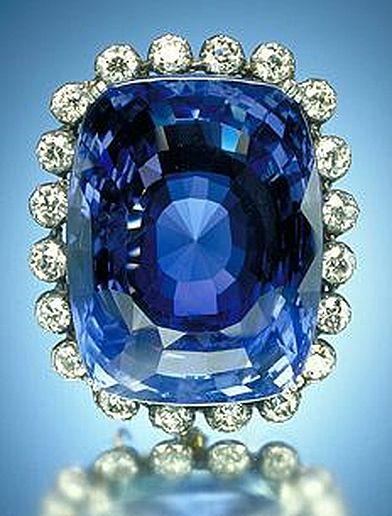
The name sapphire derives from the Latin "sapphirus", a term that derives from a Greek word with similar pronunciation.
It was also called hyacinth, meaning "blue colored lily."
In the Middle Ages, the old Spanish word safirí was used to refer to the blue sapphire (safirí means "blue colored").
There are sapphires of different colors: green, yellow, violet, pink, orange, as well as of many intermediate colors. Sapphires can show the effects of color changes and may present asterism. Orange corundum is also known as padparadscha, a term derived from the Sinhalese word that means "lotus flower." The leuco-sapphire is a colorless sapphire.
Those born in October have two protective stones:

In 1952, the Jewelers of America association included the Tourmaline in the list of birthstones, becoming the second birthstone for October.
The black Tourmaline has been traditionally used to gain protection from bad energies, negative thoughts, bad influences, etc.
The name comes from the Sinhala word "tourmali", meaning stones of different colors. Tourmaline is the name of a group of related mineral species, with a very complex chemical composition.

Tourmaline is the queen of color. We find tourmalines in all colors: Multicolor, Bicolor, Red, Orange, Yellow, Green, Blue, Purple, Violet, Brown, Neon Blue, Colorless, etc., It can also present Asterism, Color Change, Trapiche (radial pattern). EVERYTHING.

The most appreciated color variety is the Paraiba Tourmaline (showing intense blue and green, colored by copper), followed by Rubellite, Indicolite, Chrome Tourmaline and Bi Color. In today’s market, saturated colors are in high demand, although in recent years less saturated colors, such as pink tourmalines, have gained many a following.

More information about Tourmaline: A multicolor Gemstone

The Opal is associated with good luck, it is the birthstone for October and the gem fo 14th wedding anniversaries.
The name for the opal comes from the Sanskrit word "Upala", meaning precious stone or stone par excellence.

The Greek word "opallios" means "to see a change of colors".
The opal is an amorphous substance that belongs to the silica group. It is formed by a series of spherical microscopic structures of various sizes, which diffract light to show a beautiful play of colors.
Novembre has two birthstones:

Topaz is the birthstone for November. The Blue Topaz is the gem gifted for 4th wedding anniversaries, and the Imperial Topaz is gifted for those celebrating their 23rd anniversary.
Making us stronger, restoring our soul, dispelling anger, breaking spells, curing insomnia or giving us a longer life are just some of the many legends and powers that have been attributed to the Topaz for centuries.

The etymology of the word topaz is uncertain.
In the first century AD, the Roman writer Pliny suggested that the name came from the Greek word "Topazos", an island in the Red Sea. Another theory suggests that the name comes from the Sanskrit word "pita" meaning fire, and that it makes reference to the yellow color of some topazes.

The most common Topazs are colorless (white) and brown. The blue color, for the most part, is due to the treatment of the stone. We can find colorless, brown, yellow, blue, orange, purple, pink and red Topazes.
More information about Topaz Gemstone.

The Citrine, along with Topaz, corresponds to those who are born in the month of November. Citrine is also used to commemorate the thirteenth wedding anniversary.
In 1952, the Jewelers of America organisation added the Citrine to the list of birthstones.
As with all stones, Citrine is also attributed with having healing powers. Radiating positive energy, generating stability, protection, and alleviating depression are just some of the powers attributed to it. It is also known as the merchant's stone (as many companies keep a Citrine crystal in their register boxes to attract good fortune and business success).
 Citrines are perfect gemstones to use in jewelry. Its good degree of hardness, transparency, brightness and its affordable price for large stones, as well as for stones of all sizes, means that this beautiful and attractive yellow gemstone is widely used in today's market.
Although Citrine is a rare variety of Quartz, (it should be noted that the vast majority of quartz that is currently sold is Smoked Quartz or thermally treated Amethysts), there are not so many pieces of antique jewelry on the market for us to have had the opportunity to identify the stone, unlike other gems.
More information about Citrine.

In 2002, AGTA (American Gem Trade Association) added the Tanzanite to the ist of Birthstones for December.
Tanzanite is a precious stone that has recently entered the market. Tiffany & Co was the first company to, thanks to a great marketing campaign, introduce it to the international market.

The most important gemological variety of Zoisite is the Tanzanite. It owes this name to its place of origin, Tanzania, still the place of the only deposits found.
Because it is only mined in a particular area of Tanzania, deposits are likely to be depleted within a few decades.
The Tanzanite is usually a violet color with brown tones. To avoid these brownish tones, the Tanzanite is generally treated, achieving much more intense blue-violet colors.
Turquoise is the birthstone for December as well as for 11th anniversary wedding anniversaries. It is associated with good luck.
It was a stone that was greatly appreciated by the ancient civilizations of Mexico.
Turquoise has been used as an ornamental gemstone since ancient times. It was already known in 3000 B.C. and possibly before the first dynasty in ancient Egypt.
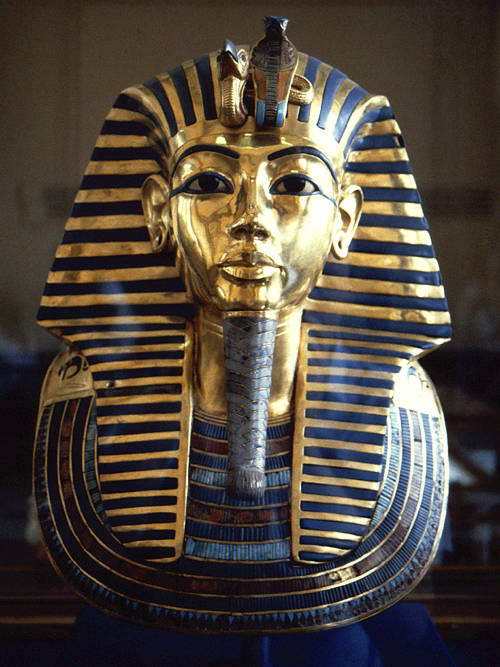
Tutankhamun's mask. It contains inlays of coloured glass and gemstones, including lapis lazuli, quartz, obsidian , carnelian, feldspar, turquoise, amazonite, and other stones Fuente: Wikipedia By Jon Bodsworth
The term turquoise, used since antiquity, has an unknown origin. One theory suggests that it is derived from the ancient French "tourques" which meant "stone of Turkey", not because the gem came from this country, but because the Persian Turquoise, and perhaps the one from the Sinai peninsula, reached Europe viaTurkey.
Turquoise is a phosphate hydrated aluminum and copper, which has a blue or blue-green color, and may present black streaks (matrix) that are remnants of the parent rock.
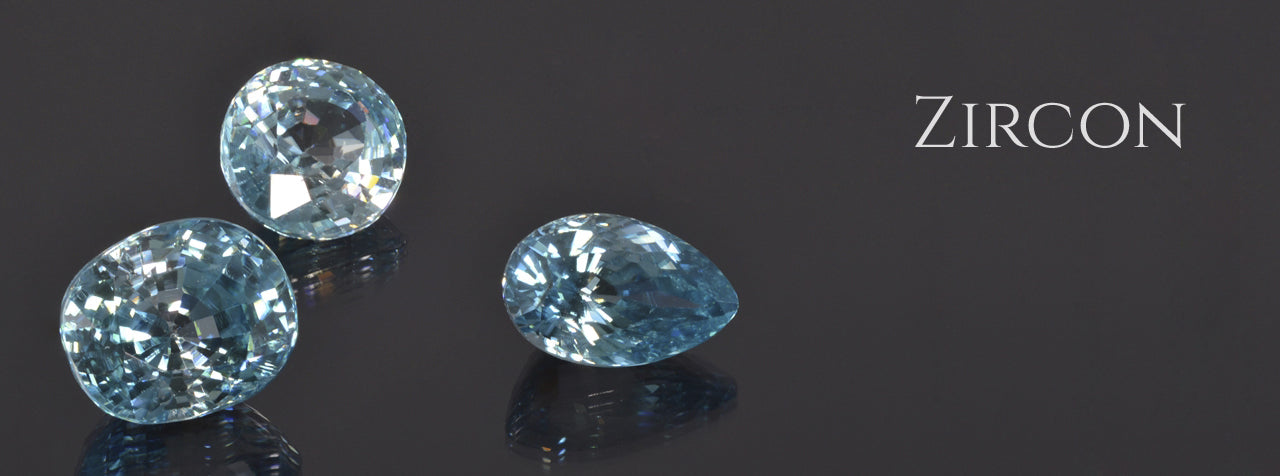
In 1952, the Jewelers of America organisation added the Zircon to the list of birthstones for the month of December. It is believed that the Zircon attracts prosperity.
The name for the Zircon stone seems to derive from the word "zargoon" which in Arabic means "vermilion" (cinnabar powder used to obtain deep red paint) and in Persian means "golden color".

In the 18th century, the colorless zircons found in Matara (Sri Lanka) were erroneously considered to be diamonds of low quality and denominated "Matara diamonds."
Discover the Zircon Collection.
If you are interested in knowing more about list of gemstone varieties by color, click here.


